Checking cache…
Module 1 · Lesson 112 min
What is the Forex Market?
An introduction to the world's largest financial market.
What is the Forex Market?
What is the Forex Market?
Imagine you're going on holiday to America. You take your British pounds to the airport and swap them for US dollars. That swap is forex! Forex (foreign exchange) just means exchanging one country's money for another country's money.
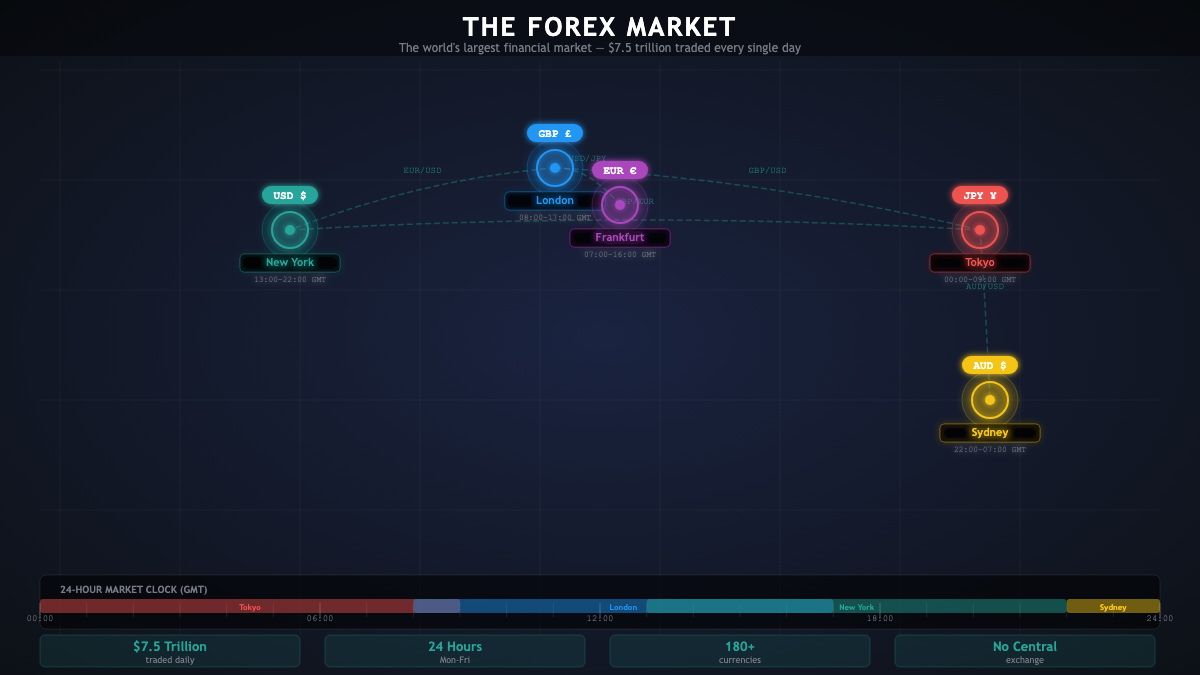
Now imagine millions of people, banks, and companies doing that every single second, 24 hours a day. That's the forex market — and it's the biggest financial market in the entire world, with $7.5 trillion traded every single day.
🚗 Real World Analogy
Think of forex like a giant global car boot sale, except instead of swapping old toys, countries are swapping currencies. When Britain needs euros to pay a French company, that's a forex trade. When a hedge fund bets the pound will fall, that's a forex trade too.
Think of forex like a giant global car boot sale, except instead of swapping old toys, countries are swapping currencies. When Britain needs euros to pay a French company, that's a forex trade. When a hedge fund bets the pound will fall, that's a forex trade too.
3 Things That Make Forex Special
- Open 24 hours, 5 days a week — There's always a market open somewhere in the world (London, New York, Tokyo, Sydney). You can trade at 3am if you want!
- No central building or exchange — Unlike the London Stock Exchange, forex has no headquarters. It's all done electronically between banks and brokers around the globe.
- You can profit when prices go UP or DOWN — Unlike buying shares (where you only win if the price rises), in forex you can "go short" and profit when a currency falls.
Who Actually Trades Forex?
- Big banks (like Barclays, JPMorgan) — trade billions per day for clients and themselves
- Governments & central banks — control their country's currency value
- Hedge funds — speculate for huge profits
- Businesses — a UK company buying products from Japan needs to buy yen
- You! — retail traders (everyday people) now have access through online brokers
⚠ Caution
Forex is a real business, not a get-rich-quick scheme. The majority of new traders lose money because they skip education and risk management. Finish this entire course before risking real money.
Forex is a real business, not a get-rich-quick scheme. The majority of new traders lose money because they skip education and risk management. Finish this entire course before risking real money.
Key Terms to Remember
- Forex / FX — Foreign Exchange (swapping currencies)
- OTC (Over-The-Counter) — trades happen directly between parties, not on a central exchange
- Liquidity — how easy it is to buy or sell. Forex is extremely liquid — you can always find a buyer or seller
- Volatility — how much the price moves. More movement = more opportunity AND more risk
Knowledge Check
1 / 3
What is the approximate daily trading volume of the forex market?
AI Tutor
Ask anything about this lesson
Online
Enter to send · Shift+Enter for new line